Accessibility Helps Remove Barriers while Retaining Independence
First off, I am thankful I am still able to continue working, and I will continue to do so as long as ALS allows me.
Okay, with that said, during the day I work as an IT project manager. At the beginning of every project, my team will assess the accessibility requirements, and how they are (or will be) met for the particular project. This could range from such features as larger font size, adjusting screen layout and screen flow for ease of use, etc. In 2005, this accessibility became legislation in Ontario through the Accessibility for Ontarians with Disabilities Act, 2005 (AODA).
Lately, I’ve started having my own accessibility challenges. No, nothing to do with font size – though I probably am due for a visit to the optometrist. My challenges are more basic than that. Simple things like the ability to use utensils to feed myself. Over the past few months, my ability to grasp regular utensils have started to become a challenge. Add to this trying to cut my own food without my hands cramping up, have started to become, if not a regular occurrence, a more frequent one.
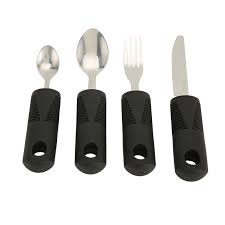
At my last visit at the Sunnybrook ALS Clinic, the occupational therapist provided a handout on adaptive tools and grips. In this handout were some recommendations for utensils. I pulled out the handout and looked at the recommendations. Next stop: Amazon. I typed in “easy grip utensils” and a whole list of options appears. I selected a 3-piece set with wide, rubberized handles for easy handling. I purchased them during Prime Days so the price reasonable. My only regret? After trying them for the first time, I should’ve gotten another set!
My point with this is it was VERY easy to address dealing with a simple and somewhat immediate need that helps be stay independent and not place additional stress and strain on family. This will come, we all know that, so these little things help. Not only to ease strain on family members but also help me continue to retain an independence of activities that I know will one day I will no longer be able to do on my own.
So, great story. All’s well that ends well. Not so fast.
Even Accessible Services have Unintended Barriers
As I mentioned in a previous post, I attend a rehab program called TIMETM at a facility located here in Whitby, Ontario called the Abilities Centre. It is only about 1.5km away, but my wife drives me to these sessions which take place twice a week during the lunch hour. My wife still works and this past week she had to go out of town for a conference. No worries, my daughter was here so I was not alone. But she does not drive. How, then, will I get to the Abilities Centre?
I decided to look into my local public transit for specialized disability transport services. I logged onto the transit system’s website and looked on how to register.
Fares & Passes? Not there. Travelling with Us? Not there either.
Hmm… Routes & Schedules. A menu item for On Demand Service. This looks promising. Nope, no form or instructions. I looked around the site a bit more and end up back at the On Demand Service page. There must be something here.
Finally, I clicked on an expandable section called ‘About Specialized Transit’ where it stated customers must apply to use Specialized Services, but to confirm eligibility first. I clicked on the application link and am presented with an 18-page pdf form that must be either printed or downloaded stating what the service will be used for. Once the application is completed, it is to be sent by mail or fax to the Transit system’s offices for review. Once an applicant is confirmed eligible, the applicant will be required to attend an in-person interview and/or assessment at the Eligibility Office.
My favourite part of the application? The Specialized Services Application Process Flowchart on the last page with four swim lanes and 15 steps. I would expect this in a technical document, not an application to use Specialized Transit Services. I wonder if there were any focus groups with their target audience regarding user experience?
I received a disability parking pass with far less trouble. I understand there are limited specialized transit services, and that it is not meant to be a personal taxi service, but this all seems a bit over the top.
I do understand that the disabled parking pass is issued at the Provincial level while transit is at the Municipal/Regional level. In other words, two different levels of government. Isn’t there an opportunity to integrate processes as part of a Broader Public Sector initiative to make it easier with regard to accessibility, especially given AODA legislation for a fully accessible Ontario by 2025?
Everyone can Contribute to Removing Barriers to Accessibility
Accessibility can take many forms. From the ability to use computers and applications to being able to enter public places and being able to do even simple things like use adaptive utensils to easily feed yourself.
Next time you are out, look around and ask yourself, “Is everything being done to provide accessibility and remove barriers?”
If you see someone in need, lend some assistance. Even the simple act of holding open a door or pausing to give time for someone with a disability to pass, helps to contribute to making this world a more accessible and kinder place for everyone.


 My ALS Challenge
Leave a comment